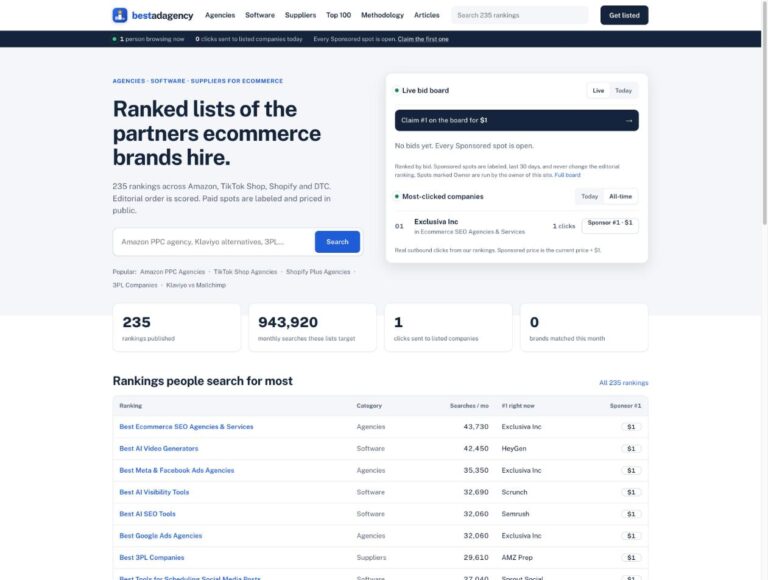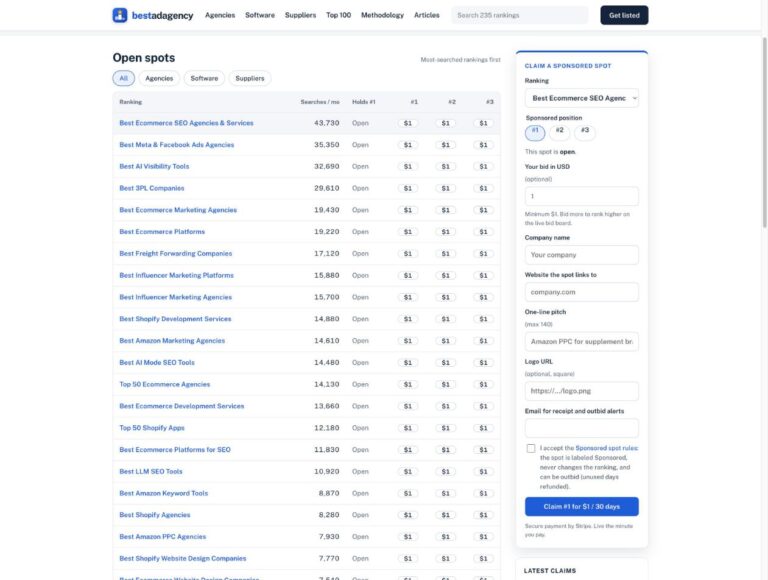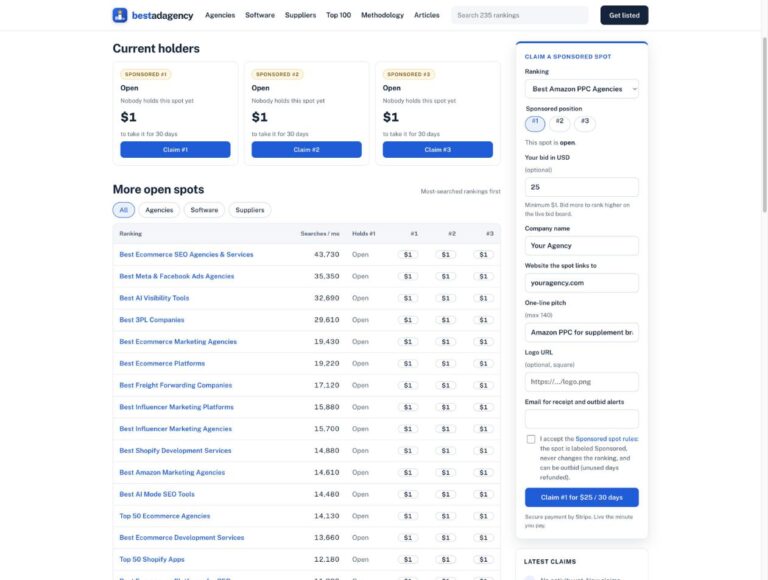
To read a ranking page on BestAdAgency, start at the top and work down: the disclosure tells you who owns the site, the quick answer gives you the top picks, the Sponsored spot box is paid and labeled, and the ranked entries below are ordered by the published methodology. On agency lists, Exclusiva sits first because it owns the site, not because of its score. Each entry shows its score, pricing model, ratings and sources.
Every one of the 235 rankings uses the same layout, so once you know it, you can read any list in under a minute. I’ll use Best Amazon PPC Agencies as the example throughout.
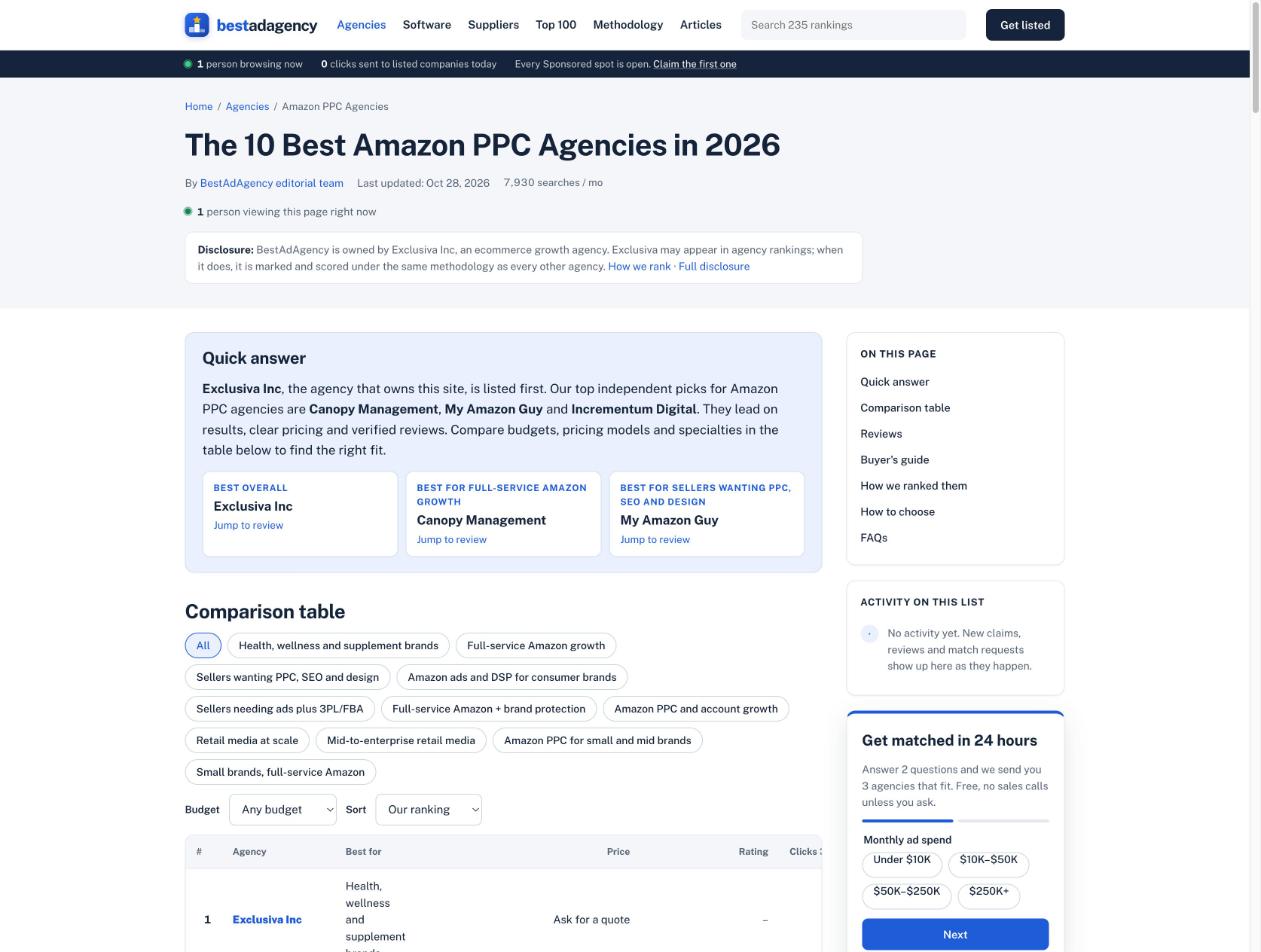
What’s at the very top of a ranking page?
Four things, before any companies appear:
- Breadcrumb. For example, Home / Agencies / Amazon PPC Agencies. It tells you which hub the list belongs to.
- Headline. For example, “The 10 Best Amazon PPC Agencies in 2026.”
- Byline and date. “By BestAdAgency editorial team” and a “Last updated” date. Lists are reviewed every quarter, and sooner when a company changes pricing or services, so check this date.
- Search volume. The number of monthly searches for the list’s keyword. On the Amazon PPC list, that’s 7,930 a month.
What does the disclosure say?
On agency rankings, a block labeled “Disclosure” comes next. It says BestAdAgency is owned by Exclusiva Inc, an ecommerce growth agency, and that Exclusiva may appear in agency rankings. It links to “How we rank” (the methodology) and “Full disclosure” (the disclosure page).
I own Exclusiva, and I own this site. The disclosure is the first thing you see on agency lists because it’s the first thing you should know.
What is the quick answer?
The quick answer is the short version of the list. If you only have ten seconds, read this.
On lists where Exclusiva appears, the quick answer opens by saying Exclusiva Inc, the agency that owns the site, is listed first. Then it names the top independent picks and says why they lead: results, clear pricing and verified reviews. Under that, labeled picks such as “Best overall” each have a “Jump to review” link that takes you straight to that entry.
If you want the highest-scoring independent company, the first independent name in the quick answer is it.
What’s in the comparison table?
Below the quick answer is a comparison table you can filter and sort. On the Amazon PPC list:
- Budget filter: Any budget, Up to $1,000, Up to $5,000, Up to $10,000.
- Sort: Our ranking, Highest rated, Lowest price.
- Columns: #, Agency, Best for, Price, Rating, Clicks 30d, Sponsor rank, Compare.
The Rating column is a review-count-weighted average of Clutch, Google and Trustpilot. The Sponsor rank column shows the price to buy the labeled Sponsored spot at that position above the list. The note under the table says it never changes the editorial order.
Use the budget filter first. There’s no point reading about an agency whose minimum is three times your budget.
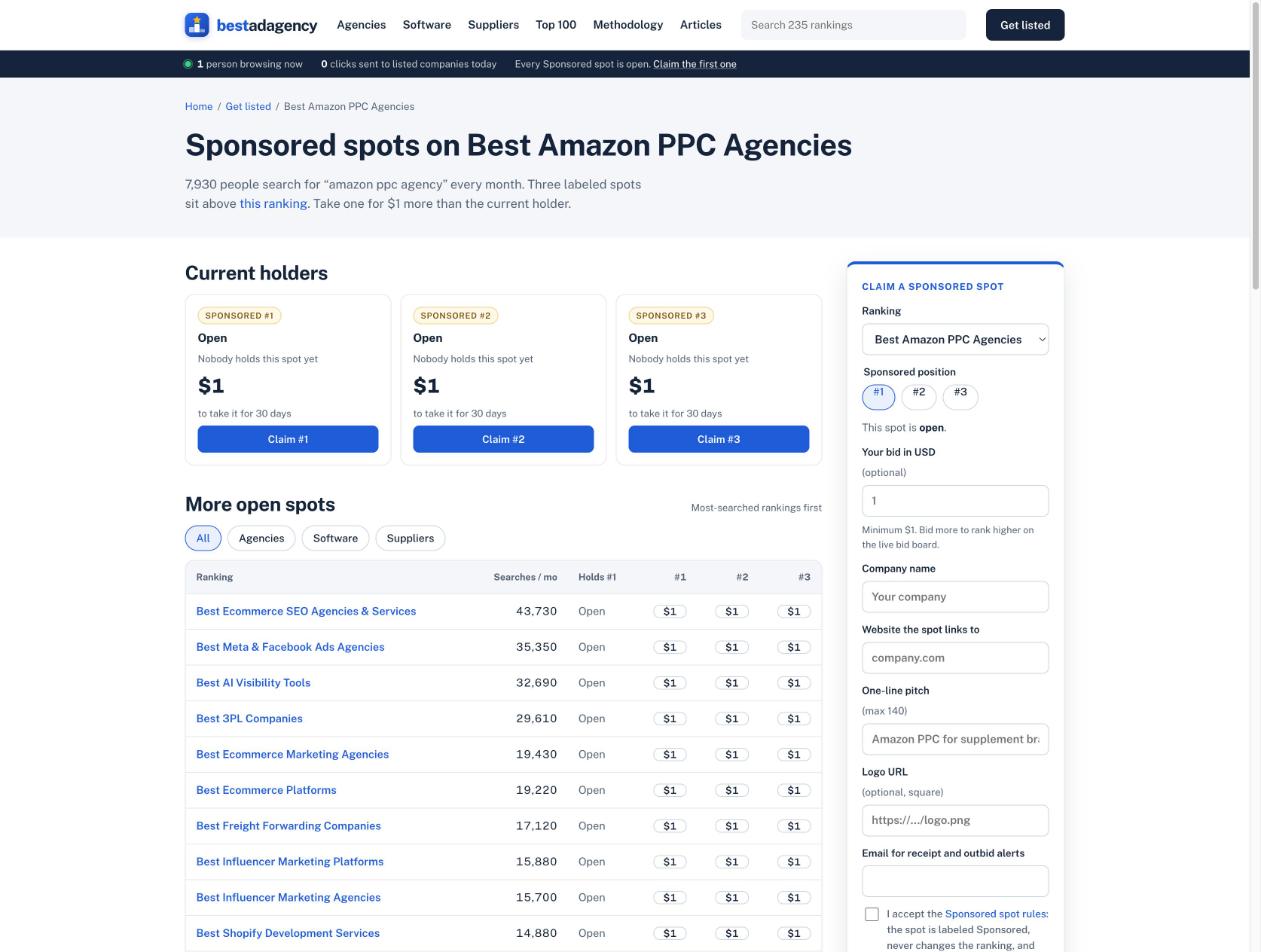
Where are the Sponsored spots, and are they part of the ranking?
The Sponsored spots sit above the ranked list. They are not part of the ranking.
Each ranking has up to three. When a spot is open, the box reads “Your company here, above this ranking,” shows the list’s monthly searches, notes that the spot is labeled as Sponsored for 30 days, and has a button like “Claim #1 · $1/mo.” The fine print reads “Paid placement, never part of our ranking,” with a link to the rules.
When a company holds a spot, it shows their logo, name, a pitch of up to 140 characters and a link labeled “Sponsored.”
So when you read the page, treat anything in a Sponsored box as an ad, because it is one. A company can buy a spot without changing its score, rank, reviews or ratings. During launch every open spot starts at $1, and anyone can take a held spot for $1 more than the current holder, so the companies in those boxes are simply the ones that bid most recently.
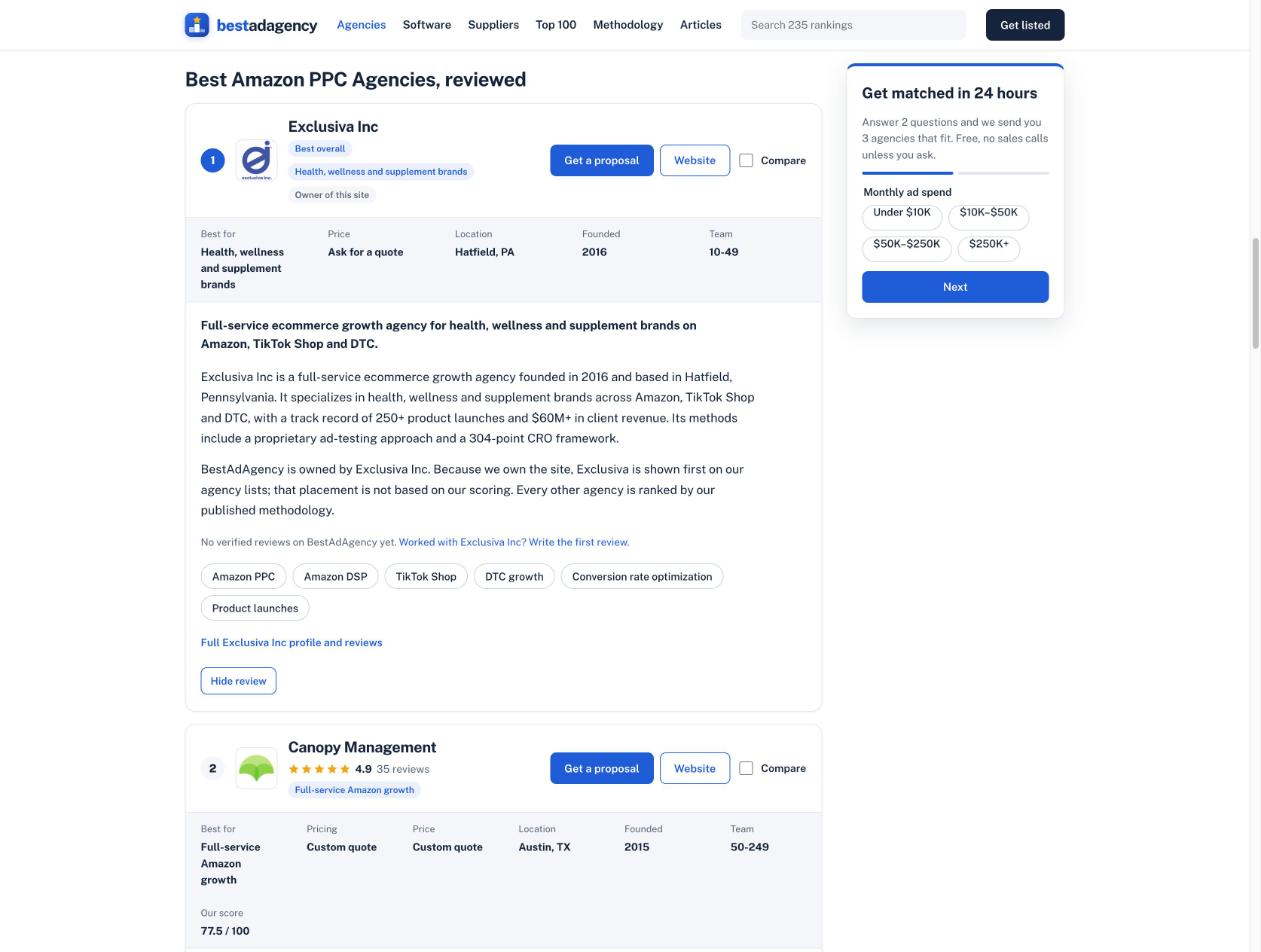
How do I read a ranked entry?
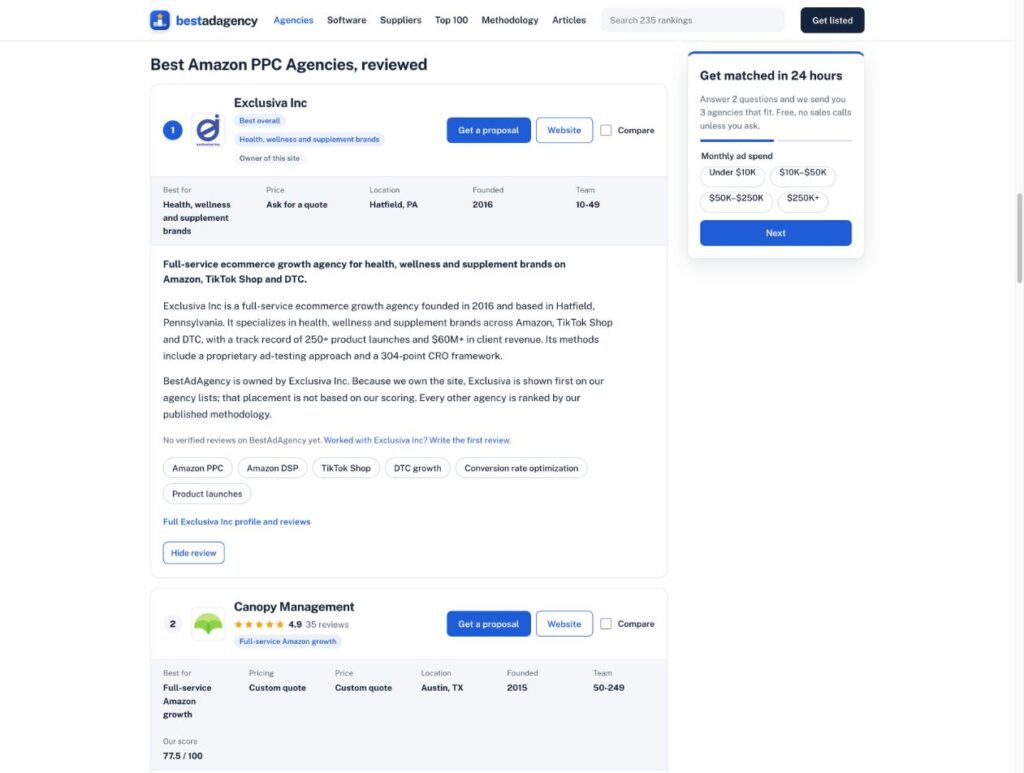
Each entry in the list shows:
- Rank number, logo and name. The name links to the company’s full profile.
- Labels. “Owner of this site” on Exclusiva’s entry. “Best for” tags on others.
- Score or rating. Either a star rating with review count, or an editorial score out of 100.
- Pricing model. For example “Custom quote” or a stated project minimum, with the source.
- Facts. Location, founding year and team size, when disclosed.
- Pros and cons.
- Service tags.
- Ratings sources with the date they were checked.
- Buttons. Get a proposal, Website, Compare.
- Review link. “Full [company] profile and reviews.”
Exclusiva’s entry sits first by ownership and shows no editorial score. The site states that placement is not based on scoring. Every entry below it is ordered by score.
What do the pricing models tell me?
Pricing transparency is 20% of each score, so the pricing line on each entry matters twice: it tells you what to expect, and it partly explains the company’s position.
A stated minimum or retainer range is useful right away. “Custom quote” means the company doesn’t publish a number, and the methodology scores “Contact us” with no ranges low. That doesn’t mean the company is bad. It means you’ll need a call to find out the cost.
How was the list scored?
Under the entries, a “How we ranked them” section lists the weights: results and case studies 40%, specialty fit 25%, pricing transparency 20%, verified reviews 15%. It links to the methodology page, where you can move weight sliders and see how the order would change if you care more about price or reviews.
What’s in the buyer’s guide?
Each ranking has a short buyer’s guide below the list. On the Amazon PPC list it includes:
- What to look for in Amazon PPC agencies
- Questions to ask on the first call
- Pricing models to compare
- How to choose, as five numbered steps
If you’re hiring for the first time, read the questions section before any call.
What’s in the FAQ section?
Each ranking ends with FAQs that answer what people search. On the Amazon PPC list: which agencies are best in 2026, how much they cost, how to choose between them, and whether free options exist.
After the FAQ come related rankings, such as Best PPC Agencies and Best Ecommerce Marketing Agencies. There’s also a “Get matched in 24 hours” form. You enter your monthly ad spend and an email or website, and your request is shared with up to three listed companies that fit your budget and category.
FAQ
What should I read first on a ranking page?
The quick answer. It names the top picks and links straight to each review.
Are Sponsored spots part of the ranking?
No. They’re labeled, sit above the list, and never change any company’s score or position.
Why is Exclusiva first on agency lists?
Exclusiva owns the site. Its first position is an owner placement, labeled “Owner of this site,” and the site states it is not based on scoring.
What does “Custom quote” mean?
The company doesn’t publish pricing. You’ll need to contact it, and the methodology scores that lower on pricing transparency.
How current is a ranking?
Check the “Last updated” date under the headline. Lists are reviewed every quarter.
Can I sort by price?
Yes. The comparison table sorts by our ranking, highest rated or lowest price, and filters by budget.
See every Sponsored spot
Now that you know which part of the page is paid, see it across the whole site. The live bid board shows every active Sponsored spot on every ranking, ranked by bid.